
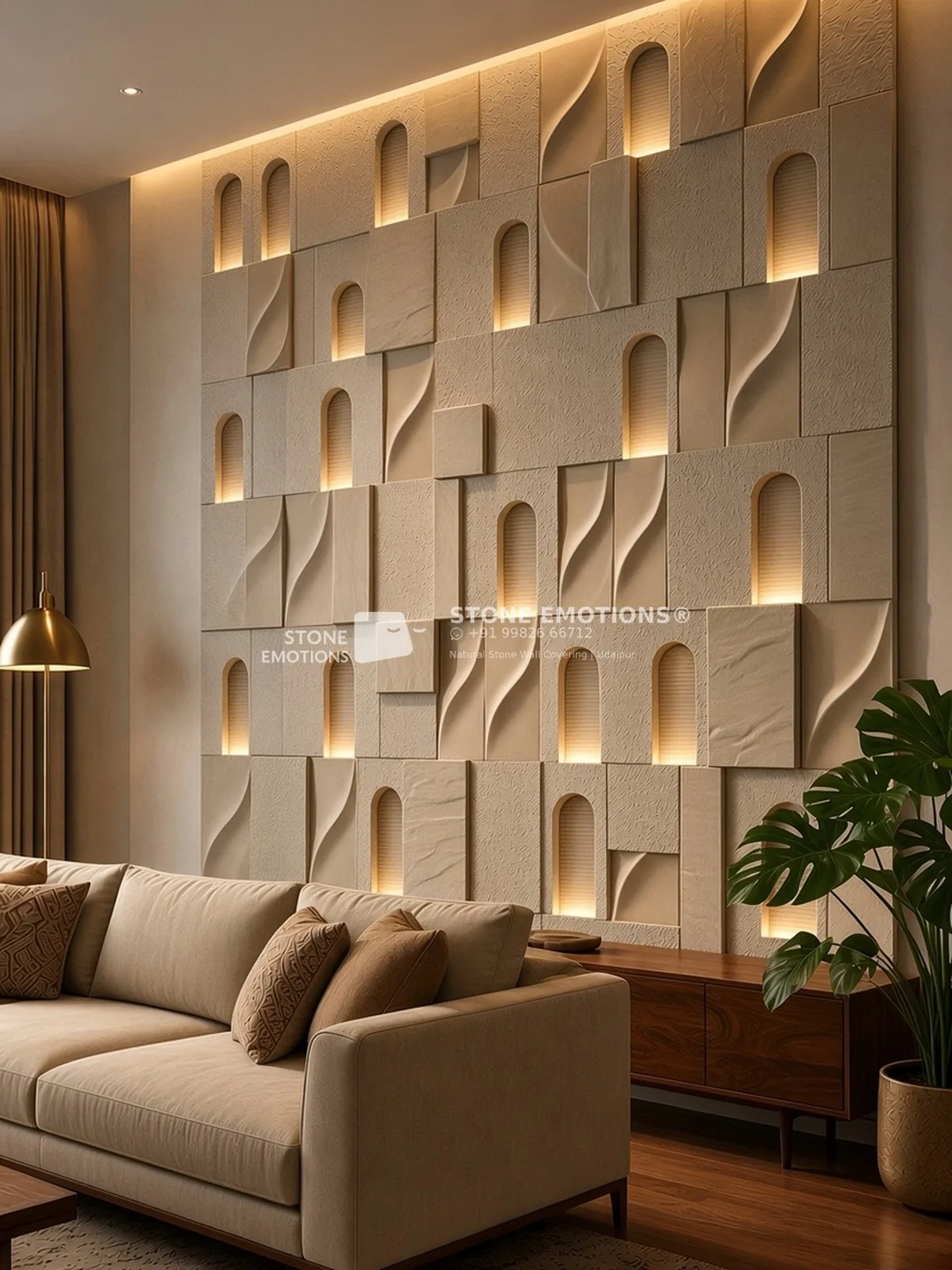
A Jharokha 3D stone mosaic wall is a feature wall of mixed Gwalior sandstone modules – fluted arch niches, S-curve wave tiles and rock-face, sandblasted and honed tiles at varied depths – with a warm LED uplight hidden at the bottom sill of each arch, giving a living room, lobby, hotel or restaurant a warm, Rajasthan-rooted focal wall.
What is the Jharokha 3D stone mosaic wall?
The jharokha is the overhanging arched window of Rajasthani havelis and palaces. This design brings that arch into a contemporary 3D mosaic: small arch niches are scattered across the wall in a free rhythm, framed by tiles of different textures and projections, so the surface never looks flat or repetitive.
Because every module sits at its own depth, the wall changes through the day. Grazing light picks out the cleft rock-face and the carved waves, while the lit arches glow softly in the evening.
Which modules make up the mosaic?
- Arch niches with horizontal fluted grooves: the jharokha element, recessed into the tile with fine horizontal flutes inside the arch.
- S-curve wave carved tiles: a single flowing S-curve carved across the face for soft movement.
- Natural cleft rock-face tiles: the split face of the stone, left natural for strong texture.
- Sandblasted rough tiles: an even, matt, slightly gritty finish.
- Smooth honed tiles: calm, flat surfaces that rest the eye between the textured pieces.
- Varied depths: modules are set at different projections to create shadow lines across the wall.
Each carved module is CNC-machined for accuracy and then hand-finished. Read more in our guide to CNC relief, 3D carving and stone engraving.
Why Gwalior sandstone for a 3D mosaic?
Gwalior sandstone is a fine-grained natural sandstone in warm beige-buff tones. Its even grain machines cleanly, so the flutes, arches and S-curves stay crisp, and it also splits well for a natural rock-face finish. The same stone can be honed, sandblasted or left cleft, which lets one material carry all the textures of the mosaic.
- Warm, natural colour that pairs well with wood, brass and soft lighting.
- Natural variation in shade from tile to tile – no two walls are identical.
- Matt surface that does not create glare under lighting.
- Porous, so sealing is recommended in wet or exterior locations.
Comparing stones? See sandstone or marble for a carved stone wall.
How is the arch LED uplight hidden?
A warm white LED strip sits in a concealed channel at the bottom sill of each arch niche, so light rises from below and grazes up over the horizontal flutes. The source is hidden from normal viewing angles, and the glow fades toward the top of the arch.
- Use warm white (around 2700–3000 K) to suit the buff sandstone.
- Use an aluminium profile with a diffuser for an even line of light.
- Plan wiring routes, drivers and service access before the tiles are fabricated and fixed.
- Add a dimmer so the wall works as both a feature and ambient light.
More ideas in lighting for carved stone relief walls.
Video
Where can a Jharokha stone mosaic wall be used?
- Living room feature wall: behind a sofa or around a TV, with the arches lit in the evening.
- Lobby or reception: residential and office lobbies, where the mosaic scales across larger walls.
- Hotels: receptions, corridors and restaurant walls that want a Rajasthani character.
- Restaurants and cafés: a warm, textured backdrop that photographs well.
- Exterior walls, with care: use a breathable sealer, IP-rated lighting and good drainage, and avoid locations with constant water run-off.
See also the Gwalior Mint sandstone arch rhythm living room wall.
How do you maintain a sandstone mosaic wall?
- Dust regularly with a soft brush, dry microfibre cloth or a vacuum brush attachment for the grooves.
- Clean marks with plain water and a pH-neutral stone cleaner.
- Avoid acids, bleach, harsh chemicals and pressure washers.
- Apply a breathable penetrating sealer, and re-seal periodically on exterior or high-use walls.
- Check LED profiles and drivers through the planned access points.