
When a client asks which stone is best for a feature wall, the honest answer is a question: where is the wall, and what should it do? Sandstone, marble and granite are all natural stones with long histories in Indian architecture, but they behave very differently on a wall. One carves softly and glows under warm light, one brings brightness and veining, and one stands up to sun and rain with little fuss.
This guide compares the three for architects, interior designers and homeowners who are specifying a feature wall, from a living room relief to an exterior elevation. It builds on our shorter note on sandstone or marble for a carved wall, adding granite and looking more closely at exposure, finish and maintenance.
The three stones in brief
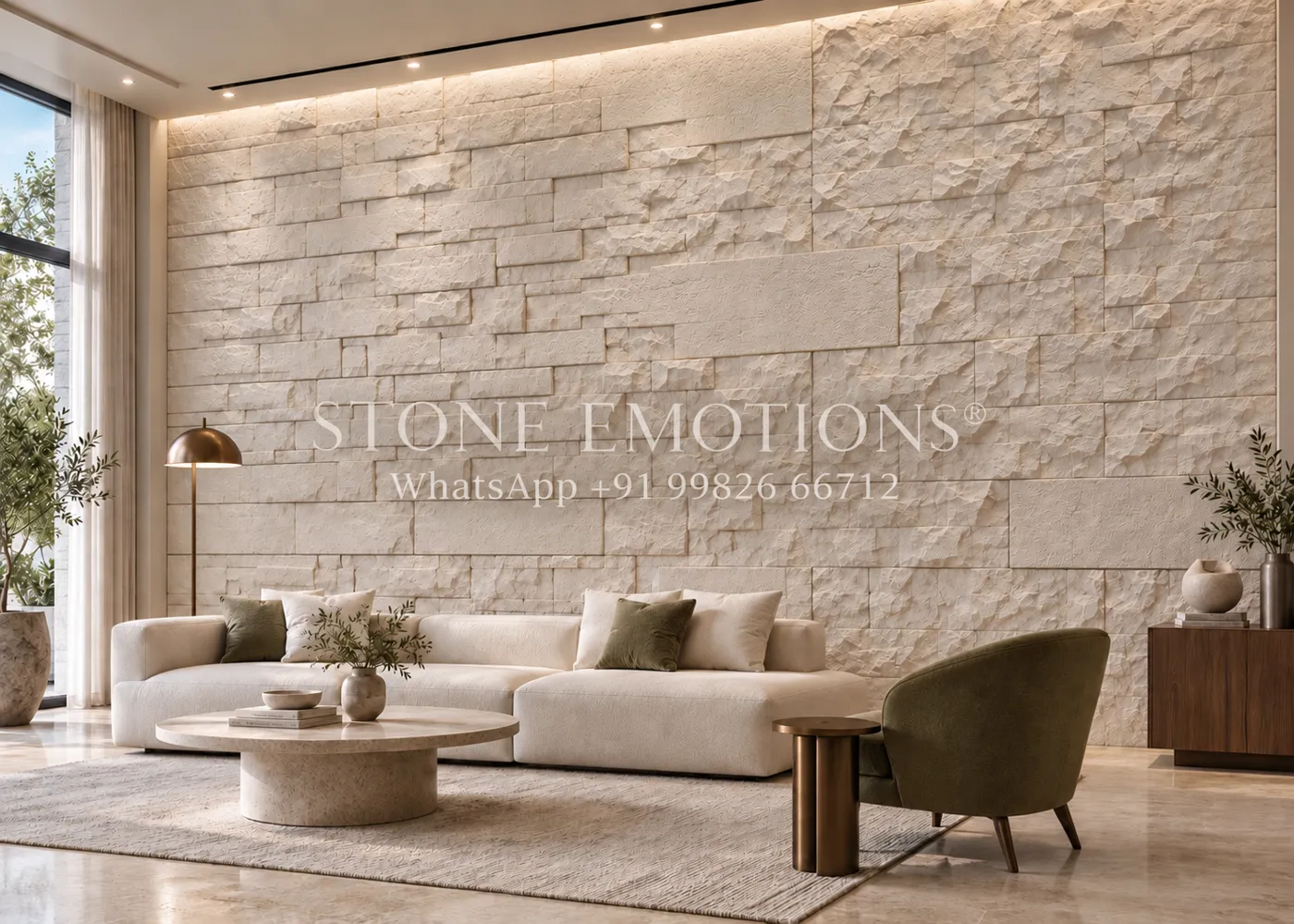
Sandstone
Sandstone is a sedimentary stone formed from compacted grains of sand. Its surface is usually matt and granular, with a soft, natural texture. Indian sandstones such as Gwalior White, Gwalior Mint, Ivory, Yellow and Red Sandstone are widely used for carved murals, jali and elevations. Sandstone is relatively porous, which gives it its warm, tactile character and also means it absorbs water and stains more readily than denser stones.
If you are considering one of the most carved-friendly varieties, our page on Gwalior Mint sandstone murals explains how this stone is typically used.
Marble
Marble is a metamorphic stone, formed when limestone recrystallises under heat and pressure. It has a finer, crystalline surface, often with veining, and can be honed to a soft sheen or polished. White marbles, including Vietnam White and Banswara White, give interiors a bright, refined field. Marble carves well with careful tooling, but it is sensitive to acids and can etch or stain.
Granite
Granite is an igneous stone, formed from cooled magma. It is dense, hard and has low porosity, which makes it highly resistant to weathering. It comes in a wide range of colours and patterns. Its hardness makes deep, intricate figurative carving more demanding, so granite feature walls generally lean towards strong surface finishes, geometric patterns and clean cladding rather than detailed relief.
Comparison table
| Factor | Sandstone | Marble | Granite |
|---|---|---|---|
| Character | Warm, matt, earthy, tactile | Bright, refined, often veined | Dense, speckled or patterned, strong |
| Carving response | Very good for relief, murals and texture | Good with careful tooling; fine detail possible | Harder to carve; best for geometric work and textured finishes |
| Porosity | Higher | Moderate | Low |
| Typical interior use | Living room murals, mandir backdrops, foyers, staircase walls | Mandir backdrops, living and bedroom walls, refined lobbies | Strong contemporary walls, high-use areas |
| Exterior suitability | Widely used on Indian elevations with correct stone selection and detailing | Better in sheltered or interior locations | Very suitable, including heavy-rain and coastal sites |
| Common finishes | Natural, honed, rock face, sandblasted, carved, fluted | Honed, polished, lightly textured, carved, engraved | Flamed, leather, honed, polished, textured |
| Maintenance focus | Protection against water and stains; gentle cleaning | Avoid acids; wipe spills; pH-neutral cleaners | Low; routine cleaning |
Treat the table as a general starting point. Each stone family includes many varieties, and the particular block, thickness and finish you approve matter more than the family name.
Interior or exterior?
Interior feature walls
Indoors, the decision is mostly about character, light and the type of design. Sandstone suits relief murals and textured walls where you want shadows to play across the surface. Marble suits brighter, quieter interiors, mandir backdrops and walls where veining or a fine finish is part of the design. The Botanical Passage reference, in Banswara White Marble with a honed and lightly textured surface, shows how marble can carry a botanical gesture while keeping broad quiet areas.
Granite indoors is a good choice for very high-use spaces, for a bold contemporary look, or where a darker, stronger surface is wanted. It is less often the first choice for delicate carved art.
Exterior walls and elevations
Outdoors, the stone must handle sun, monsoon rain, heat and, in some cities, salt air. Dense, low-porosity stones such as granite, quartzite and basalt are the most forgiving here, particularly in humid or coastal locations. Sandstone is also widely used on Indian exteriors, but variety selection, sealing where appropriate, drainage and detailing matter a great deal. Linear Strata, a Gwalior Mint sandstone reference with a rock-face finish, is an example of a textured exterior direction.
Marble is generally better kept for sheltered or interior locations, since weathering and acid rain can dull its surface.
For external work, also plan for water runoff, joint design and mechanical support where needed. Our article on stone wall cladding installation planning covers these points.
Finish changes everything
The same stone can look completely different depending on its finish, so discuss finish as seriously as the stone itself.
- Natural or rock face: rugged, shadowed and forgiving of wear; common for sandstone exteriors.
- Honed: smooth and matt; a calm finish that suits most interior walls in all three stones.
- Polished: reflective; used mainly on marble and granite. On a feature wall it can create glare under strong lighting.
- Sandblasted, shot-blasted or bush-hammered: textured surfaces that add grip, softness of tone and visual depth.
- Flamed or leather: typical granite finishes for exteriors and contemporary textures.
- Carved or fluted: relief, engraving and flutes made by CNC machining and hand finishing.
Look at finish samples under the lighting you plan to use. Grazing light exaggerates texture; flat light softens it.
Maintenance in everyday terms
Sandstone: Dust or brush regularly. Avoid harsh chemicals and high-pressure washing on carved detail. Discuss whether a protective treatment is suitable for the specific stone and location, especially near water, kitchens or diyas.
Marble: Wipe spills promptly, particularly anything acidic such as lemon, vinegar or some cleaning products. Use pH-neutral cleaners. Honed marble shows etching less than polished marble.
Granite: Routine cleaning with mild products is usually enough. Darker polished granites can show dust and water marks more visibly.
For all three, ask your supplier for written care guidance for the actual stone and any protection applied, and include it in the project handover.
Cost and availability
Price depends on the stone variety, block selection, thickness, finish, carving complexity, panel size and installation scope. As a broad rule, sandstone is often more economical than marble, while granite and quartzite vary with availability and finish. Your actual figure is set after the design, stone and quantity are reviewed.
How to decide
- Fix the location and exposure first: interior, semi-covered or fully external.
- Decide the design language: detailed relief, quiet texture, veining or strong geometry.
- Shortlist two or three stones that suit both, using our materials guide.
- Review physical samples in the planned finish and lighting.
- Check thickness, panel layout and fixing for the chosen stone and wall.
- Agree maintenance before handover.
Discuss your feature wall
Stone Emotions LLP is based in Udaipur, Rajasthan. Our founder, Tarun Dave, has been in natural stone since 1998, and we partner with architects, interior designers and homeowners on carved walls, cladding and elevations. Share your wall location, dimensions and a design reference, and we will help you compare the right stones.
- Send an enquiry: Contact Stone Emotions
- WhatsApp: +91 99826 66712