
A pooja room is often the smallest room in a home, yet it is the one people care about most. A natural stone backdrop can give that wall a sense of permanence and calm, but only when the stone, the design, the light and the installation are chosen together.
This guide is for homeowners, interior designers and architects who are at the selection stage: you know you want a stone mandir backdrop and now need to decide which one. (If you are earlier in the process, our shorter note on planning a stone mandir backdrop covers the sequence from site to enquiry.)
Start with how the mandir will be used
Before you look at designs, write down how the space is actually used. A few questions make a real difference:
- Is it a dedicated pooja room, a niche in the living area, or a wall in an apartment passage? A closed room can take more detail; an open niche seen from the sofa often needs a quieter design.
- Will you light diyas and agarbatti every day? Smoke, soot and ghee affect how a stone surface looks over the years, and this should guide the finish you choose.
- Is there water use, such as abhishek, near the wall? Splashing water and kumkum or haldi stains need to be planned for.
- Do you sit or stand for puja? Eye level sets where the main motif should sit.
Your answers become the brief for the stone team.
Choosing the stone
Most home mandir backdrops we discuss are in sandstone or marble. Both are natural materials, and every block varies in colour and grain, so treat the descriptions below as directions, not promises. Always approve a physical sample of the actual stone.
Sandstone
Sandstones such as Gwalior White, Gwalior Mint and Ivory Sandstone have a soft, matt, slightly earthy quality. They take carved relief well and feel warm under lamp light. Because sandstone is porous, it is more likely to absorb oil, ghee and coloured powders, so placement of diyas and an appropriate protective treatment should be discussed for the specific stone.
A good example of a restrained sandstone direction is Shanti Axis, a design reference in Gwalior White Sandstone that uses a shallow Om relief and fine vertical flutes rather than ornate borders.
Marble
White marbles, including Vietnam White, give a brighter, cleaner field and a finer surface. They suit apartments and contemporary interiors where the pooja wall must sit comfortably next to modern joinery. Marble is sensitive to acids, so lemon, some cleaning chemicals and certain puja materials can mark it if left on the surface.
Deepa Cascade is a marble design reference that keeps the lower field calm around the idol and places the decoration higher up, which is a useful idea for any mandir where the deity must remain the focus.
Mixed materials
Some designs combine stone with brass, onyx or inlay. Each added material brings its own care needs, so ask how it will be cleaned and how it will age next to the stone.
Choosing the motif
Figurative or symbolic?
There are broadly three families of design:
- Figurative relief — Radha Krishna, Ganesha, Lakshmi, Buddha and similar compositions. These are powerful but demand the most care in drawing, carving depth and joint placement. The Radha Krishna Vrindavan relief is one figurative marble reference from our library.
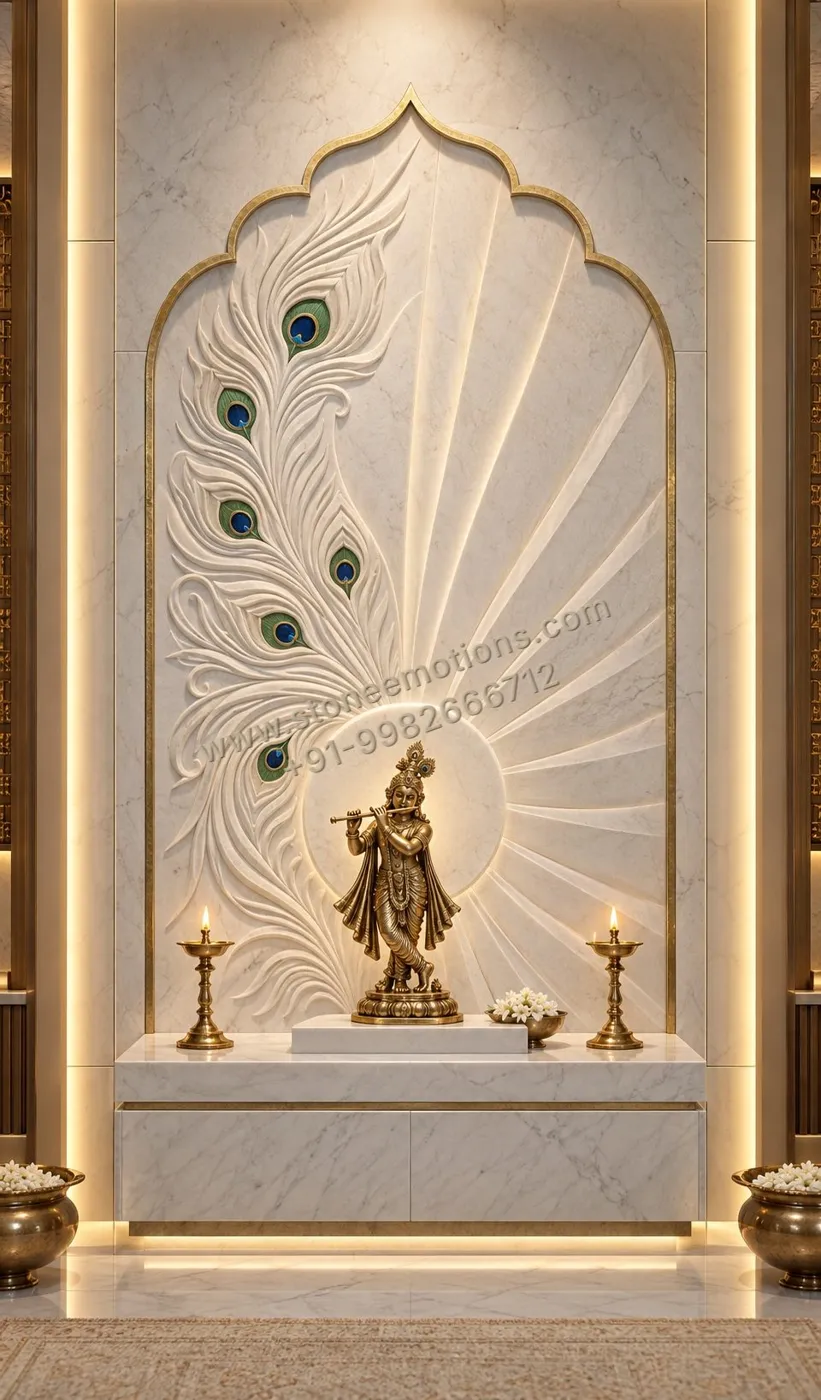
- Sacred symbols — Om, lotus, kalash, diya, peacock, Kalpavriksha. These give meaning with less visual weight and are often easier to fit into smaller walls.
- Geometric and textural — mandalas, flutes, arches and quiet textures that frame an idol you already own without competing with it.
If your idol or murti is detailed, a simpler backdrop usually honours it better. If the wall itself is the focus, perhaps with no separate idol, a figurative relief may be right.
Keep a clear hierarchy
Decide on one focal point. Then let the rest of the wall support it with quieter carving or plain stone. Negative space is not wasted space in a pooja room; it is what makes the main element feel calm. You can browse more references in the mandir and sacred walls collection to see how different designs handle this balance.
If your family follows particular iconographic or Vastu guidance, share it at the start so the composition is developed around it rather than adjusted later.
Getting the size and proportions right
A stone backdrop should be designed for your wall, not scaled up or down from a catalogue image. When you measure, note:
- the full wall width and height, and the ceiling height;
- the pedestal or mandir unit size and its height from the floor;
- the idol height and the space you want around it;
- doors, switches, niches, shelves and any beams or columns nearby;
- where you usually stand or sit, and the viewing distance.
As a working principle, the main motif should relate to the idol and to eye level, and it should not be hidden behind the pedestal, flowers or lamps.
Large backdrops are made in panels. Ask to see the panel layout with the design, and make sure joints do not cut across a deity's face, hands or the central symbol.
Planning the lighting
Light decides how carved stone reads. A relief that looks flat under a ceiling light can come alive when light grazes across it from above or the side.
- Warm light generally suits a pooja room and flatters sandstone and marble. Check the effect on your actual sample under the lamp you plan to use.
- Grazing light from a concealed top or side strip brings out relief depth.
- Backlighting is only possible when the design and assembly are planned for it, for example with translucent inserts. It cannot be added to a solid carved panel afterwards.
- Diyas add moving, low light. Consider where they sit so that smoke does not rise directly against the most detailed part of the carving.
Plan wiring, drivers and access before the stone goes up. Our article on lighting a carved stone relief wall explains these principles in more detail.
Installation and care
Installation
The fixing method depends on the wall, the panel size and weight, and the relief thickness. Smaller, lighter panels may be fixed with a suitable adhesive system; heavier or larger work may need mechanical support. This is a project-specific decision for the stone supplier, the site team and the architect, not a one-size-fits-all choice. Check that the wall is sound, dry and plumb, and that plumbing or wiring inside it is mapped.
Everyday care
Dust gently with a soft dry cloth or brush. Avoid acidic or harsh cleaners, especially on marble. Wipe oil, ghee and kumkum spills promptly. Ask for written care guidance for the specific stone and any protection applied.
What does a stone mandir backdrop cost?
There is no single price, because the stone, relief depth, design complexity, size and installation scope all change the figure. Our temple backdrops page explains how those factors affect a quote. Your actual figure is project-specific and is set after the design and scope are reviewed.
Begin your mandir backdrop
Stone Emotions LLP is based in Udaipur, Rajasthan. Our founder, Tarun Dave, has been in natural stone since 1998, and we work closely with homeowners, interior designers and architects. Share your wall dimensions and a reference, and our team will help you choose the stone, design and next steps.
- Send an enquiry: Contact Stone Emotions
- WhatsApp: +91 99826 66712